top of page
  • Facebook
  • Youtube
  • Google
  • Whatsapp
  • Airbnb
  • Instagram
Asana Tribe Yoga Spain Lotus Flower

ASANA TRIBE YOGA BLOG

Learn more about yoga, wellness, and healing


Balance is about so much more than standing on one leg.It’s about trust, awareness, strength, and the quiet confidence that comes from feeling steady in your own body.


At Asana Tribe Yoga, we see balance as a conversation between body, mind, and nervous system — especially for women in midlife, those recovering from injury, or anyone feeling a little ungrounded in today’s fast-moving world.


The beautiful thing? Balance can be trained at any age and any stage of your yoga journey.


Let’s explore why balance matters, and share practical, accessible exercises you can start using today.


Why Balance Is So Important (On and Off the Mat)


Good balance helps to:

  • Prevent falls and injuries

  • Strengthen stabilising muscles in the feet, ankles, hips, and core

  • Improve posture and joint health

  • Build body awareness and coordination

  • Support emotional steadiness and mental focus


As we age, after injury, or during hormonal changes such as menopause, balance can feel more challenging — not because we’re failing, but because the body is asking for more mindful support.


The Hidden Secret to Better Balance


Balance isn’t just about muscle strength.It relies on three key systems working together:

  1. Proprioception – your body’s ability to sense where it is in space

  2. Core and hip stability – deep muscles that hold you upright

  3. Nervous system regulation – staying calm instead of tensing or panicking


When we slow down, breathe, and move with awareness, balance naturally improves.


Practical Yoga Exercises to Improve Balance


These gentle yet effective exercises can be practised at home or integrated into your yoga routine.


1. Foot Awakening & Grounding (2–3 minutes)

Balance starts at the feet.


Try this:

  • Stand barefoot

  • Slowly shift your weight forward, back, and side to side

  • Spread your toes wide and press evenly into all four corners of each foot

  • Imagine roots growing down into the earth

This improves foot strength and proprioception — essential for stability.


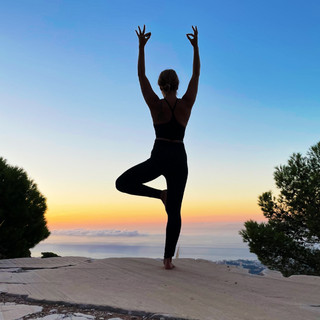
2. Tree Pose (Vrksasana) – With Support

Tree Pose is a classic balance posture, but it doesn’t need to be rigid.


How to practise:

  • Stand near a wall or chair

  • Place one foot against the ankle or calf (avoid the knee)

  • Keep a soft bend in the standing leg

  • Hands can rest at the heart or lightly touch the wall


🧘‍♀️ Tip: Fixing your gaze on one calm point (drishti) helps the mind settle.


3. Heel-to-Toe Walking (Mindful Balance Drill)


This simple exercise is powerful for coordination.


How to practise:

  • Walk slowly in a straight line

  • Place the heel of one foot directly in front of the toes of the other

  • Move with awareness, using your breath to stay relaxed


✨ Excellent for improving balance after injury or during recovery.


4. Single-Leg Stand with Breath Awareness


Sometimes stillness is the most challenging practice.


Try this:

  • Stand on one leg

  • Keep your breath slow and steady

  • Notice any wobbling without judgment

  • Gently engage your core and relax your jaw


💛 This teaches patience, self-trust, and nervous system regulation.


5. Chair Pose Variation (Utkatasana)


Strength supports balance.


How to practise:

  • Bend your knees slightly as if sitting back into a chair

  • Keep weight in the heels

  • Engage the core and lengthen the spine

  • Option to lift one heel or alternate legs


🔥 Builds leg strength and stability while staying accessible.


Balance Is Also Emotional


When life feels uncertain, the body often reflects that instability.Yoga teaches us how to stay present during wobble — without gripping, forcing, or judging ourselves.

Every time you lose balance and return, you’re practising resilience.


A Gentle Reminder


Balance doesn’t come from pushing harder.It comes from listening, slowing down, and building trust with your body.


At Asana Tribe Yoga Spain, our classes are designed to support:

  • Injury recovery

  • Menopause and hormonal changes

  • Nervous system regulation

  • Confidence and self-connection


You don’t need to be “good at balance” to practise balance — that’s the practice itself.


Want to Practise Balance in a Supportive Space?


Join us for small-group yoga, beach yoga, and mindful movement in Mijas Pueblo, where balance is explored gently, safely, and with compassion.

🌿 Your body already knows how to find stability — yoga simply helps you remember.


There are moments in running a small business that feel quietly overwhelming — and then there are moments that stop you in your tracks completely.


When my Facebook account was hacked and my business presence suddenly shut down, it felt like the ground disappeared beneath me.


Overnight, the platform I relied on to share class schedules, events, messages, and inspiration was gone. Years of posts, connections, conversations, and community-building — inaccessible. I couldn’t explain what had happened. I couldn’t reach many of you. And for a while, I didn’t know if I’d be able to rebuild at all.


I was devastated.


The Emotional Impact of Being Suddenly Disconnected


As a small business owner, especially in wellness, social media isn’t just marketing — it’s connection. It’s where we speak from the heart, share offerings, and stay visible in a fast-moving world.


When that was taken away without warning, I felt grief, panic, and a deep sense of loss. Not just for my business, but for the relationships I feared I’d lost touch with.


There were moments of self-doubt. Moments where I wondered if I’d done something wrong, or if all the energy I had poured into building Asana Tribe Yoga Spain had simply vanished.


It’s not often spoken about, but when your livelihood is tied to an online platform, losing access can feel deeply personal — even destabilising.


The Unexpected Gift of a Social Media Pause


And yet, something unexpected happened.


With no option to post, promote, or scroll, I was forced into a social media break I hadn’t planned — and honestly, probably wouldn’t have chosen.


At first, it felt unbearable. Then, slowly, it became revealing.


I noticed how much quieter my mind felt without constant notifications. I had more presence with my students in the room. More time to reflect on why I started teaching yoga in the first place — not for algorithms or reach, but for real human connection.


I returned to the essence of the work: holding space, teaching from lived experience, and being present with those who showed up.


The break reminded me that my business is not a platform — it’s people.


How the Yoga Tribe Community Held Me Up


What carried me through that period wasn’t visibility — it was community.


Students reached out through other channels. People shared word-of-mouth recommendations. Some of you checked in, booked classes, brought friends, and simply showed up.


That support meant more than you may realise.


When you choose to attend a class, share a post, recommend a teacher, or stay connected, you are actively sustaining a small business. You are helping a real person continue doing work they care deeply about.


Asana Tribe Yoga Spain exists because of the tribe — because of trust, loyalty, and shared values. This experience showed me just how powerful that support truly is.


What This Experience Taught Me as a Small Business Owner


Being hacked was painful. But it also brought clarity.


I learned:

  • Not to place all my trust in one platform

  • That rest from constant online presence can be nourishing

  • That community is stronger than algorithms

  • That my work has value beyond social media metrics


Most of all, I learned that resilience is not about doing everything alone — it’s about allowing yourself to be supported.


Why Your Support Truly Matters


When you follow, share, attend, or recommend a small business, you’re doing more than clicking a button.


You’re:

  • Supporting someone’s livelihood

  • Helping keep independent wellness spaces alive

  • Choosing connection over convenience

  • Investing in real, embodied experiences


In a world that often feels fast and impersonal, your support helps small businesses like mine continue offering spaces of care, presence, and healing.


Moving Forward with Gratitude


I wouldn’t wish the experience of being hacked on anyone. It shook me. It challenged me. It changed how I relate to my business and social media.


But it also deepened my gratitude — for this community, for the work I do, and for the reminder that what we build together offline matters just as much, if not more, than what we share online.


Thank you for being here.

Thank you for supporting small business.

Thank you for being part of this tribe.


With all my heart,

Lisa

Asana Tribe Yoga Spain 🤍


Have you ever started moving slowly, mindfully — maybe in yoga, breathwork, or somatic exercise — and suddenly felt tears rise for no obvious reason?

Nothing “happened.”

No memory appeared.

No story explained it.

And yet… something released.


This is not weakness.

It’s not imagination.

It’s not random.

It’s the body doing what it has always known how to do — release what it has been holding.


The Body Remembers What the Mind Learns to Forget


In The Body Keeps the Score, psychiatrist and trauma researcher Dr. Bessel van der Kolk explains that experiences — especially overwhelming or stressful ones — are not only stored as memories in the brain, but as sensations, tension patterns, and nervous system responses in the body.


When emotions cannot be safely felt at the time — grief, fear, anger, shock — the body adapts. Muscles tighten. Breath shortens. The nervous system shifts into survival.

This isn’t a failure.

It’s intelligence.


But what was once protection can later become pain, anxiety, numbness, or chronic tension.

Somatic exercise offers a way back — not through analysis, but through felt experience.


Why Somatic Exercise Works Where Talk Sometimes Can’t


Somatic practices work bottom-up, meaning they begin with sensation rather than thought.

Instead of asking “Why do I feel this way?”, we ask:

  • What do I notice in my body right now?

  • Where is there tension, heaviness, warmth, or movement?

  • What happens if I breathe with this instead of away from it?


This is important because trauma and suppressed emotion often live below conscious thought.


Dr. Gabor Maté speaks often about this, explaining that the body expresses what the mind has learned to suppress in order to survive. When emotions are not allowed expression, the body often carries them on our behalf — sometimes for years.


Somatic exercise gently invites those held responses to complete themselves.


Emotions Are Sensations Before They Are Stories


We tend to think of emotions as thoughts — but biologically, emotions begin as sensations in the body.

A tight chest.

A knot in the stomach.

A clenched jaw.


When we move slowly and mindfully, especially with breath, we begin to feel these sensations without immediately trying to fix or explain them.


And when the body feels safe enough — supported, unforced, unjudged — emotions may naturally surface.


This can look like:

  • Tears during gentle movement or rest

  • Shaking or trembling

  • Spontaneous sighing or deep breaths

  • Waves of sadness, relief, or calm


This is not catharsis for the sake of release. It’s completion.


Safety Is the Key to Emotional Release


Emotions don’t release because we push them out.They release because the nervous system finally senses safety.


Somatic exercise emphasises:

  • Slow, controlled movement

  • Choice and agency

  • Inner awareness rather than external performance

  • Rest and integration


Unlike high-intensity or purely goal-oriented exercise, somatic practices tell the body:You’re not being chased. You don’t need to brace. You can soften now.

And when the body softens, what has been held can gently move.


Why Yoga and Somatic Movement Are So Powerful Together


In trauma-informed yoga and somatic movement, the focus is not on stretching deeper or achieving shapes — it’s on staying present with sensation.


This is why emotions often surface in:

  • Hip openers

  • Slow spinal movements

  • Long exhalations

  • Stillness or Savasana


These practices access areas where the body commonly stores protective tension.

At Asana Tribe Yoga Spain, emotional release is never forced, analysed, or rushed. It is welcomed as a natural response — and equally welcomed if it doesn’t happen at all.

There is no expectation.

Only permission.


You Don’t Need to Relive the Past to Heal It


One of the most important things to understand is this:You do not need to remember or relive trauma for the body to heal.

Somatic exercise allows healing to happen through sensation, breath, and nervous system regulation — not storytelling.

Sometimes the body releases without explanation.And that is enough.


When the Body Leads, Healing Follows


Somatic exercise teaches us something deeply compassionate:Your body has never been against you.It has always been protecting you.

And when given the right conditions — safety, slowness, presence — it knows exactly how to let go.

Yoga then becomes more than movement.It becomes a conversation.

A remembering.

A homecoming.


bottom of page